he mortise and tenon joint hidden inside a 1,200-year-old temple gate at Tōdai-ji doesn't creak. Not because it's been oiled or repaired, but because the geshi — the precise alignment and dimensional relationship between the tenon and its receiving mortise — was cut to tolerances that modern laser measuring tools confirm are within 0.2 millimeters. That's not folklore. I watched a restoration carpenter in Nara check it with a digital caliper last spring, and he just shrugged. "The wood moves。" he said. "The geshi doesn't."In Japanese woodworking, geshi (sometimes written ゲシ or 下地 depending on the workshop) refers to the underlying structural logic of a joint — the hidden geometry that determines how two pieces of timber lock together before any visible surface is shaped. It's a term that doesn't translate cleanly. "Joint preparation" is too vague. "Mortise layout" is too narrow. The closest English equivalent might be "the cut beneath the cut," which sounds poetic until you realize it's literally true: every visible chisel mark on a finished beam sits on top of a geshi that was planned three steps earlier. Get the geshi wrong by a millimeter and the surface will look fine for a decade — then the joint racks。the peg works loose, and the whole assembly starts talking to you every time the humidity shifts.I've seen this failure mode in Western timber-frame construction too。though nobody there calls it geshi. A contractor in Vermont showed me a barn frame where the joiners had cut beautiful through-tenons but ignored the shoulder geometry — the geshi, essentially — and after two winters the braces had pulled proud by nearly 6 millimeters. "We focused on the show faces," he admitted. That's the trap. Geshi is invisible by design, which means it's also the first thing to get rushed when a project falls behind schedule. Traditional Japanese carpenters counter this by cutting geshi first and shaping visible surfaces last, a sequence that feels backward until you've watched a joint fail.
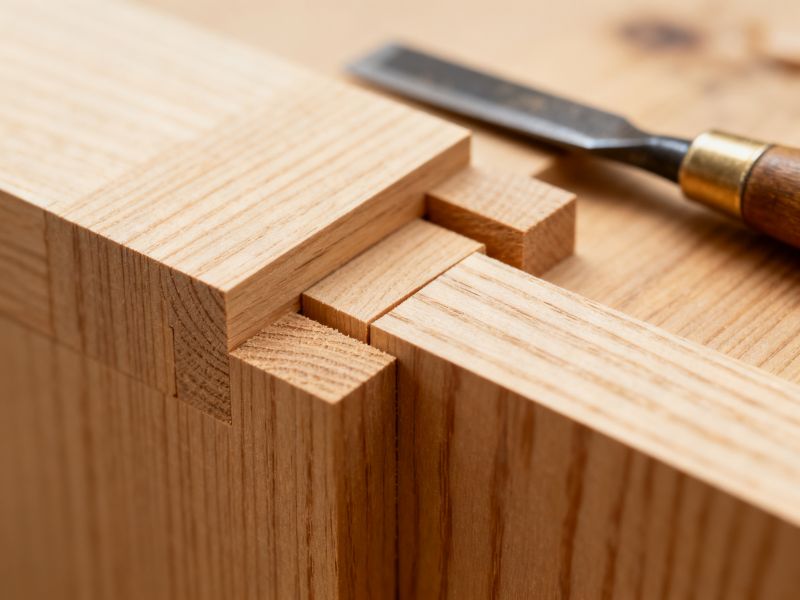
What makes geshi genuinely difficult isn't the math — it's the material. Hinoki cypress shrinks differently along the radial and tangential planes, and a geshi cut for kiln-dried stock will behave differently than one cut for air-dried timber that's still settling. The carpenters I spoke with in Kyoto's Nishijin district keep notebooks tracking shrinkage rates by tree, by slope, by season of harvest. One showed me a page from 1987 with penciled corrections for a specific mountain slope. That's not sentimentality. That's geshi maintenance — the recognition that a joint's geometry has to account for what the wood will do in five years。not just what it measures today.Modern CNC routers can cut a perfect geshi in seconds, and some high-end furniture shops do exactly that. But the operators I've talked to say the same thing: the machine doesn't know when the grain has a hidden check or when the bit is about to tear out a corner. A human hand on a chisel feels that resistance and adjusts. Geshi, in the end, is less a measurement than a conversation between the cutter and the timber — one that rewards patience and punishes shortcuts。usually about a decade later.